


Minotaur
Monthly
Monthly
September 2026
.png)


.png)


.png)


.png)
.png)




.png)

.png)

.png)


.png)







Interested in Minotaur Capital?
Subscribe to receive monthly performance updates and quarterly commentary.
© 2024 Minotaur Capital Management Pty Ltd (Minotaur). All rights reserved. See our Privacy Policy.
Minotaur Capital Management Pty Ltd (ABN 17 672 819 975) is a corporate authorised representative (CAR 1308265) of Minotaur Licensing Pty Ltd (ABN 86 674 743 198) (AFSL 557080). The Minotaur Global Opportunities Fund is issued by K2 Asset Management Ltd (ABN 95 085 445 094, AFSL 244393), a wholly owned subsidiary of K2 Asset Management Holdings Ltd (ABN 59 124 636 782).
The information in this website (the Information) has been prepared by Minotaur.
For keyboard shortcuts, press ?
This information is for general information only and is not an offer for the purchase or sale of any financial product or services. The Information has been prepared for investors who qualify as wholesale clients under section 761G of the Corporations Act 2001 (Cth) (Corporations Act) or to any other person who is not required to be given a regulated disclosure document under the Corporations Act. The Information is not intended to provide you with financial or tax advice and does not take into account your objectives, financial situation or needs. Although we believe that the Information is correct, no warranty of accuracy, reliability or completeness is given, except for liability under statute which cannot be excluded. Please note that past performance may not be indicative of future performance and that no guarantee of performance, the return of capital or a particular rate of return is given Minotaur, K2 Asset Management or any other person. To the maximum extent possible, Minotaur, K2 Asset Management or any other person do not accept any liability for any statement in this Information.
Minotaur Capital Management Pty Ltd (ABN 17 672 819 975) is a corporate authorised representative (CAR 1308265) of Minotaur Licensing Pty Ltd (ABN 86 674 743 198) (AFSL 557080). The Minotaur Global Opportunities Fund is issued by K2 Asset Management Ltd (ABN 95 085 445 094, AFSL 244393), a wholly owned subsidiary of K2 Asset Management Holdings Ltd (ABN 59 124 636 782).
The information in this website (the Information) has been prepared by Minotaur.
For keyboard shortcuts, press ?
This information is for general information only and is not an offer for the purchase or sale of any financial product or services. The Information has been prepared for investors who qualify as wholesale clients under section 761G of the Corporations Act 2001 (Cth) (Corporations Act) or to any other person who is not required to be given a regulated disclosure document under the Corporations Act. The Information is not intended to provide you with financial or tax advice and does not take into account your objectives, financial situation or needs. Although we believe that the Information is correct, no warranty of accuracy, reliability or completeness is given, except for liability under statute which cannot be excluded. Please note that past performance may not be indicative of future performance and that no guarantee of performance, the return of capital or a particular rate of return is given Minotaur, K2 Asset Management or any other person. To the maximum extent possible, Minotaur, K2 Asset Management or any other person do not accept any liability for any statement in this Information.
The Minotaur Global Opportunities Fund returned -0.1% in September, 1.9ppts behind the MSCI ACWI (Net, AUD). Some of the gap came from the rate shock. The Fed raised rates by 25bp on 16 September, its first increase since 2023, and the ECB, RBA and Bank of Japan also tightened. The US ten-year yield rose 54bp to 5.29%, and US financials had their worst month since March 2023. That hit our bank holdings and some of our longer-duration names, including the data owners in our Source basket: Moody’s, S&P Global, MSCI and Thomson Reuters.
It’s been a challenging year. Our biggest call, memory, worked, and Micron and SK hynix were by far our largest contributors. Too many of our other positions didn’t, with European defence and several of our Chinese holdings giving back much of what memory earned. Since inception we’re still 2.4ppts a year ahead, and we think the opportunities in the portfolio today are some of the most exciting we’ve had.
September’s flat number also hides how much the portfolio changed. We made 17 trades in September, against five in August, and 14 of them were buys. We sold Micron, halved SK hynix and opened six new positions. Selling memory didn’t mean moving to cash. Most of the proceeds went straight back into the market, towards companies using AI rather than the ones building it.
Memory: we sold the price, not the cycle
In September we sold our Micron position and halved SK hynix. Nothing in the thesis had broken. Micron had recovered more than 40% from its July low and was up more than 270% for the year, and the upside left no longer looked as attractive as other opportunities for the volatility that comes with it. SK hynix and Micron were in practice one exposure, so the same logic applied to both, and to how much of the portfolio’s risk they were carrying.
Efficiency was part of the picture too. High prices come down in one of three ways: supply rises, demand falls, or customers find ways to use less. Memory is now expensive enough that the third is starting to happen. When Google published TurboQuant, a technique for compressing the memory AI models use, on 24 March, we thought the market overreacted and added to memory. Micron closed at US$396 that day; by the end of September it was US$1,065. In September DeepSeek released V4.1, which needs about a quarter of the conversation memory of its predecessor, and we’ve already moved a lot of our own work from frontier models to DeepSeek.¹ We still think cheaper AI means more AI, but at today’s prices efficiency gains matter more than they did in March, for the memory makers.
Our view of the cycle hasn’t changed: we think it runs longer than the market assumed, but more of that is now priced in. We have kept some SK hynix and have a small position in Kokusai Electric as our exposure to that view. We would go back to full size if contract prices hold through the 2027 resets, spot and contract prices converge again, and the shares give us back some margin for error.
Meta: same company, new evidence
Meta launched Muse, its consumer AI agent, in the US on 8 September. It has its own computer in the cloud, browses, books and buys on your behalf, and asks before it spends, paying with one-off cards so it never sees your card details. We tested it ourselves (it isn’t available in Australia yet, so we set up a US account), and it’s the first consumer agent we’ve used that properly works. Within ten days it was the number one app on the US App Store.
We think that gives Meta the lead in consumer agents, which we think will be one of the most valuable and strategically important markets to own over the next decade. The internet’s biggest profits have gone to its gateways, the places people start, like Google for search and Amazon for shopping. An agent that books your flights and buys your groceries sits in front of all of them.
In the June quarterly we used Meta as the example of a company that “spent just as hard” without “a separately visible AI revenue stream against the spend”. Muse is the first real evidence of what that spending can produce, and at around US$725 at month end we think the market is valuing the core business and paying little or nothing for Muse. We started buying in September, and by month end Meta was our largest position. We’ll make the full case in our September quarterly.
Muse also marks a shift in where we think AI’s returns go next. For the past year our biggest AI exposure was the infrastructure being built, memory above all. Consumer agents are the first sign of those returns reaching the companies that use AI, and our other September buys follow that idea. We opened a position in Shopify (agents look beyond the big marketplaces to the long tail of stores Shopify powers) and added to Freee, the Japanese accounting-software company, whose new AI agent platform for accountants began charging in September.
Artrya: marking July’s list
Artrya fell 16% in September and 42% over the quarter, and was the month’s largest detractor. Most of September’s fall came on 10 September, when the shares dropped 19% with no announcement from the company. We think that was sympathy selling. Two days earlier EchoIQ, another ASX-listed AI cardiac company, announced that the FDA had declined to clear its heart-failure software, its first US application, and its own shares more than halved within a week. EchoIQ’s product reads heart ultrasounds rather than CT scans and is assessed on a different basis, so the decision says nothing directly about Artrya’s submissions. It did remind the market that FDA clearance for AI cardiac tools isn’t automatic. We used the fall to add to our position, because we still believe in the long-term story.
There has been real progress. Artrya finished FY26 with A$74 million of cash, all five Tanner hospitals are live, three US customers are signed and the stock joined the S&P/ASX 300 on 21 September.
The slower part is the evidence we said we were waiting for in July: rising scan volumes, plaque billings, a measurable attach rate, Cone Health going live and progress on the Flow submission. Two months on, we’re still waiting on most of it, and that’s not where we hoped to be. The biggest drag on the shares has been the delay in filing Flow, which pushes back its FDA clearance and the revenue that follows. We think these are delays rather than failures, and that the price now reflects more of the delay than the evidence justifies.
Shorts: the pipeline of pain
The short book cost a little in September as SpaceX and Apple rose, but Intuit was our best short, contributing 0.12ppts. At its 17 September investor day, the CFO called FY27 “a deliberate reset”, holding to the 9–10% revenue growth and 2–3% TurboTax growth guided in August. The shares fell 23% in the month and are down almost 60% for the year. We covered the short on 2 October.
We’ve long believed that bad news takes time to be fully reflected in share prices (we called it “Bad News Drift” in our March 2025 quarterly). Investors who have staked their credibility on a stock tend to defend it rather than change their minds, and fewer investors can or will short it, so bad news seeps into the price over weeks and months rather than all at once. Nemesis, our short-side analyst agent, is built to find those situations; internally we call her work “the pipeline of pain”. Intuit is a good example. The shares had already fallen a long way before September, and they kept falling after the investor day even though the guidance hadn’t changed.
Know your opportunity
If you only read the headline, September might look like the month nothing happened. Inside the portfolio it was a busy month, and almost every decision came down to price. We sold memory with the thesis intact because the price no longer paid us for the risk, and bought Meta because the price hadn’t caught up with a product people were already using. Artrya we added to because the price fell further than the evidence did.
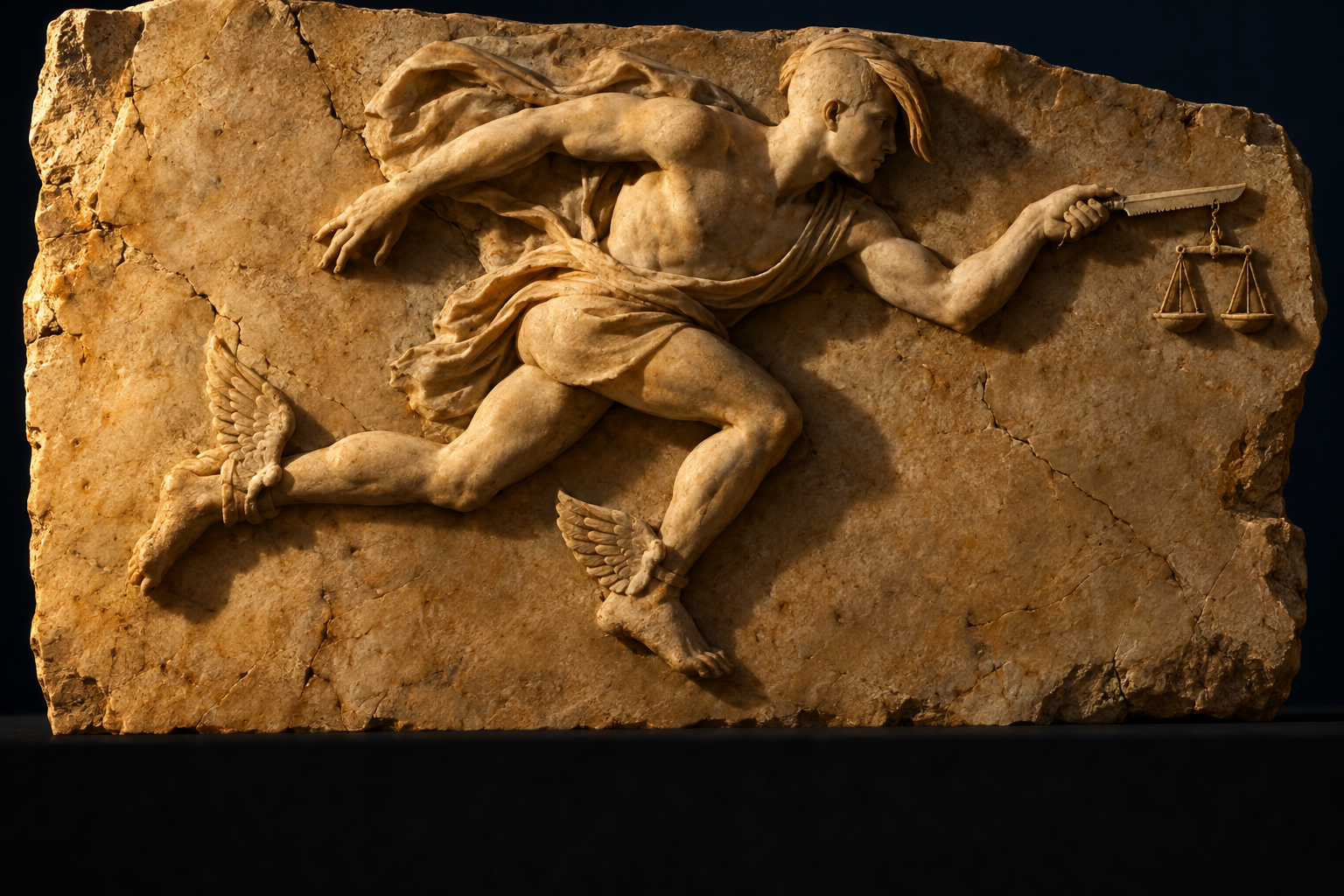
Pittacus of Mytilene, one of the Seven Sages, left a two-word instruction: καιρὸν γνῶθι, “know your opportunity”. The Greeks had two words for time. Chronos is the clock; kairos is the right moment. A year ago, memory was the moment. We think the next one is consumer agents, and it’s only just begun.
¹ Research using DeepSeek models runs through Western-hosted providers with zero data retention and model training switched off. Our “Data Classification and AI Use Policy” sets out what each provider is allowed to receive, and we’re happy to share it on request.