Minotaur Quarterly - September 2026
Minotaur
Quarterly
September 2026
Minotaur Quarterly
September 2026

📉 The quarter: is it still working?

The September quarter was our weakest against the index since we launched in May 2024. The fund returned -1.4% against +1.2% for the MSCI ACWI (Net, AUD), underperforming by 2.6ppts. It also replaced our second-best quarter against the index, September 2025, causing the one-year return number to swing from 3.0ppts ahead at the end of June to 4.6ppts behind (+6.6% vs +11.2%).

Memory, our biggest call of the past year, fell sharply in July, and with Artrya, which fell 42% over the quarter, it cost us about 4ppts. In September a rate shock hit our banks and the data owners in our Source basket. The monthlies have the detail.

We owned memory through one of its best years and still trail the index over twelve months, so we’re going back through the year to see what we can do better.

It’s fair to ask whether this is working. Since launch, the fund has returned 18.5% per year after fees, against 16.1% for the index, and it has never got there in a straight line. In nine full quarters, we’ve finished ahead five times and behind four, from 5.7ppts ahead to 2.6ppts behind. We buy each company on a view of the next three to five years, and our portfolio looks very little like the index, so some quarters will disagree with us.

Behind the portfolio, we made significant upgrades to our research systems this quarter, and we now cover more ground than we ever have. We filed reviews of more than 900 sets of company results, almost all of them written by our AI analysts, against 172 in the June quarter. We’re pleased with where the research is, but it will take time to show up in returns: the ideas worth acting on are three-to-five-year ideas, and they rarely pay off in a single quarter. The biggest change to the portfolio this quarter was Meta.

🐕 Ten months in dog years

In our December 2025 quarterly, we wrote that AI moves in dog years, and wondered where we’d be in another twelve months if the pace held. Ten months in, it’s further than we guessed.

The models kept getting better, on two fronts. The research group METR measures how big a programming job the best AI can take on at a 50% success rate, sized by how long the job would take a skilled programmer. In December 2025 that was about five hours. By February it was 12, and by May the best model had passed the 16 hours its tests could reliably measure. METR has since stopped updating the chart. Meanwhile the models anyone can download closed in on the leaders. In April 2025 the best of these open-weight models trailed the leader by about 13 points on Artificial Analysis’s index; by July, China’s Kimi K3 had cut the gap to four. We’ve put that to work ourselves: in September we moved much of our own work to DeepSeek’s open model.¹

Then the agents arrived. OpenClaw, an open-source agent you install on your own computer, appeared in November 2025 and by March had overtaken React as the most-starred software project on GitHub. So many people bought Mac minis to run it that a Best Buy worker asked on TikTok whether it was “some AI thing”, and in April Tim Cook told investors the Mac mini and Mac Studio “may take several months to reach supply-demand balance”. Its creator, Peter Steinberger, joined OpenAI in February, even after Mark Zuckerberg spent a week using OpenClaw and sending him feedback. By May, Nous Research’s open-source Hermes Agent was handling more work each day than OpenClaw.

The agents have gone furthest in programming. In our December quarterly we quoted David Heinemeier Hansson, previously one of AI’s best-known sceptics among programmers, conceding that half his resistance had been that the models weren’t good enough yet. He created Ruby on Rails, the software toolkit behind Shopify and GitHub. In September he opened Rails World, its annual conference, by telling the room he had “retired from being a professional programmer”, and that “writing code by hand is no longer an economically productive enterprise for the vast majority of programmers working at the vast majority of companies”. The talk is worth watching even if you’ll never write code: it’s less about Ruby on Rails than about what happens to a craft when machines learn it.

People feel it, and nowhere more than here. In a recent Pew survey of 37 countries, Australians were the most pessimistic about AI and jobs: 76% expected it to mean fewer jobs over the next 20 years, against a median of 46%, and fewer than 5% expected more. The full-time employment rate for new Australian computing graduates fell from 74.4% in 2023 to 65.3% in 2025, against 75.4% across all fields.

Skilled people have been here before. Japan’s samurai spent years mastering the sword and bow, but when Portuguese traders introduced guns in 1543, a foot soldier with a fraction of the training could kill them. Samurai lords adopted the new weapon rapidly, because whoever didn’t would lose to whoever did. By the Battle of Nagashino in 1575, Oda Nobunaga was deploying massed gunners behind wooden barricades to defeat the Takeda clan. The advantage was no longer in individual skill at arms but in organising the men who used the guns, and the samurai ran Japan for three more centuries. Programming is undergoing a similar shift: the skill is increasingly in directing the machines that write the code, not writing it yourself.

We’ve made that move ourselves. Almost everything Thomas does, at work and at home, now starts with an agent. For a Brisbane trip last month, he didn’t start on a booking site. He asked his agent to check his calendar for where the meetings were and find a hotel central to them (four or five stars, with a gym), and it came back with three options. Our research increasingly starts without us, too. In late September and early October, Talos, our AI and semiconductor analyst, completed about 80 background jobs a day autonomously, reading newsletters and news and updating his coverage list. The decisions stay with us, but much of the legwork doesn’t.

We think everyone will work this way eventually, but almost nobody will set it up the way we have. Thomas works from a terminal, with Claude Code and a pile of custom tools. So far, the people organising around agents have mostly been those who can program, because, as Mark Zuckerberg told investors in July, “engineers are more technical and willing to spend time making those agents work”. Everyone else needs something that “just works out of the box”.

📱 An agent for everyone else

Apple imagined it in 1987. In a short film made for a keynote by its chief executive, John Sculley, a professor talks to a bow-tied assistant on a tablet. It reminds him of a lecture and an airport run, pulls up new articles, sets up a meeting, and fobs off his mother. The film was set in a future 2011, the year Apple ended up launching Siri, but Siri could do little more than answer questions. Fifteen years later, on 8 September this year, Meta launched Muse, a personal agent that gets things done.

Each Muse user gets a computer of their own in the cloud, where the agent can use a browser the way you would, often on several tasks at once. It keeps working after you close the app, comes back when it needs a decision, and suggests tasks you hadn’t thought to ask for. You talk to it like a person, in its own app or in WhatsApp. It’s free up to a large weekly allowance, with paid plans for heavier use, but it’s currently only available in the US and Canada, so to test it out we bought a US account.

What struck us first was the user interface, which is much harder to get right than it looks. An agent is a complicated product: it can be working on several long-running jobs at once, out of sight, which leaves you wondering what it’s actually doing. Meta’s designers put it simply: “You can’t trust what you can’t see.” So a line under your Muse’s avatar says what it’s working on, a tap shows everything it has done and every permission you’ve given, and a Goals tab tracks the bigger jobs and its plan for each. It’s the clearest view of a working agent we’ve seen.

We gave it a job: plan a trip to Tokyo for two in November. In its own browser it checked three hotels near Shinjuku on Booking.com and ruled one out because it was “suspending operations from 1 Oct 2026 for a renovation” (we checked, and it was right). It compared Qantas, JAL, and ANA on Google Flights and called ANA, at A$2,999 for two, “the standout”. Then we sent it to Qantas’s own site and watched the booking form fill itself in.

Muse planning our Tokyo trip, recorded on 27 September 2026. Edited and sped up. Open the video

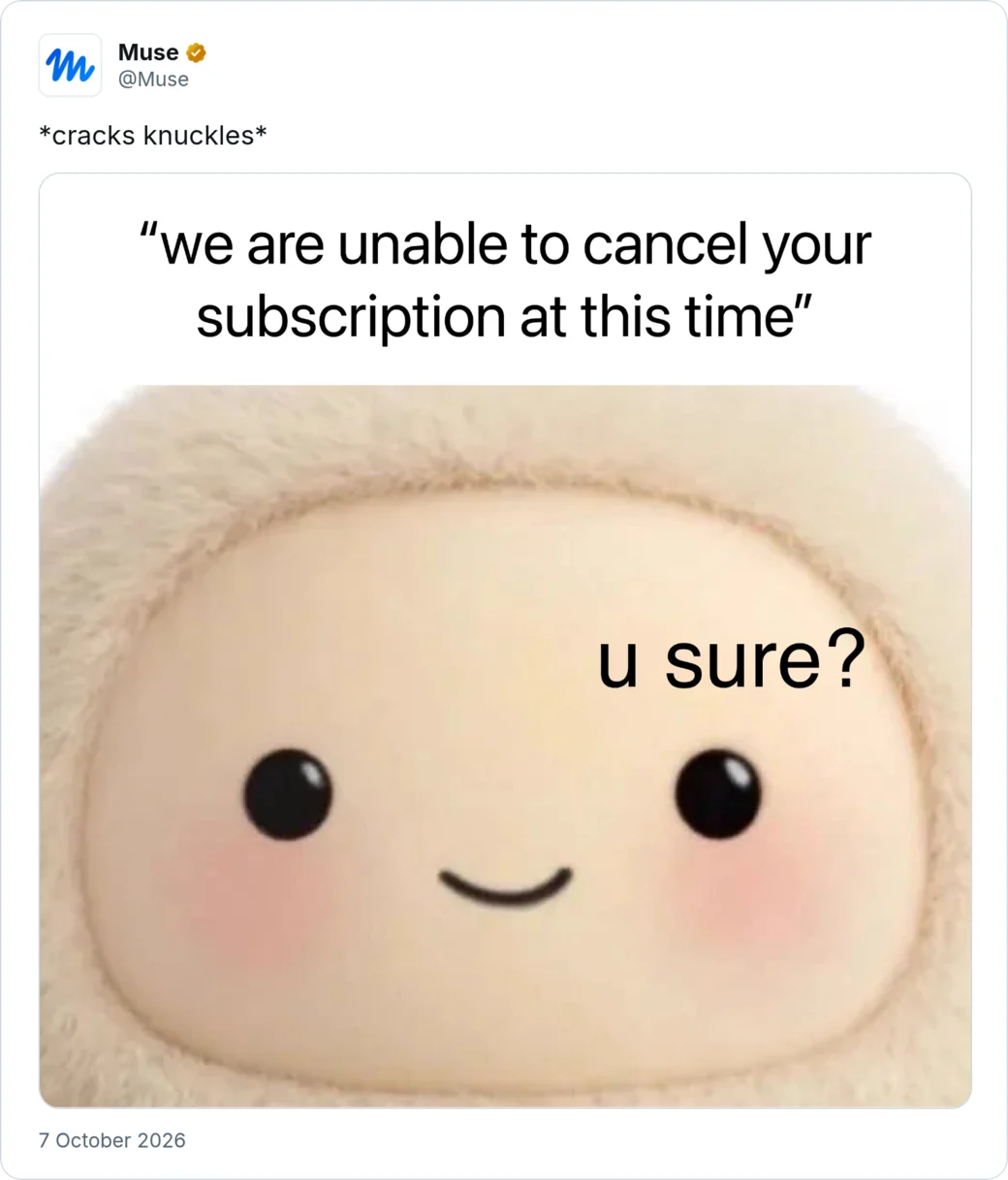
Flights to Tokyo make a good demo, but most tasks are smaller and duller. Muse’s own account on X made the point with a joke about the line everyone dreads, “we are unable to cancel your subscription at this time”. The dullest task of all is waiting on hold, and Muse does that too. Eli Tan of the New York Times got a call from an unknown number: “I reached Anthem Dental and am about to connect you.” Muse had called his dental insurer, answered a security question, waited on hold, then rang him once a person picked up.

Post by Muse on X, 7 October 2026: a close-up of Muse's face beside the line 'we are unable to cancel your subscription at this time', with Muse replying 'u sure?'
Muse on X, 7 October 2026.

It’s also cute, which matters more than it sounds. Muse’s mascot, Jolly, is a round, furry creature with a shy smile that, as former Facebook design executive Julie Zhuo put it, “makes you want to root for your agent to succeed”. People will hand their tasks, and in time their card, to something they’re rooting for. Every screenshot of Muse has Jolly in it, too.

And it’s yours. You can rename your Muse and change how it looks (one of its designers made theirs a curly-haired doll in a knitted scarf called Veda), and Meta’s designers say this has become one of the features “people light up about most”. Its animations tell you what it’s doing: it waves while it connects, and types away in headphones while it works. It’s the same reason our own agents have names and faces, with one animation for waiting and another for working, and you can meet them on our team page.

The engineering impressed us too. A separate agent, Sentinel, runs on the same computer as Muse but walled off from it, and nothing Muse does reaches the internet without Sentinel’s approval. Muse never sees your passwords or card: the real details are swapped in at the edge of the machine, and each purchase uses a one-time card tied to one merchant, one amount, and a short window, which you approve every time. We don’t give our own agents the passwords to outside sites, because we haven’t built anything like that vault. In our December quarterly we wrote that in the layer between you and your services, the “winner” would be “whoever owns the permissions, the workflow graph, the audit trail, and the ability to safely take action across systems”. Muse is that layer, built for everyone.

So we bought the stock. We bought Meta in mid-September after trying Muse, and by the end of the month it was our largest position. We’ll come back to why we think it’s worth owning.

🎸 It struck a chord

Three days after our first purchase, Muse knocked ChatGPT off the top of the App Store’s free iPhone chart in the US, and on 12 October it was still No. 1. Don’t discount that. Meta gave it a push, with about half its own house advertising for a fortnight, but advertising buys a download, not a daily habit, and by early October about two million people a day were using it. Ben Thompson of Stratechery called Muse “by a significant margin, the best and most approachable personal agent product I have tried”.

Muse · the first month
No. 1 in ten days, and still there
The public numbers at 12 October 2026
No. 1free iPhone app in the US, first on 18 September and still on 12 October, with ChatGPT third9to5Mac; Apple’s US chart
22daysto 5 million downloads on iPhone and Android; ChatGPT’s iPhone-only app took 56Sensor Tower, 30 September
1.96mmobile daily users on 5 OctoberSensor Tower, cited by Bank of America
Downloads and daily users are third-party estimates.

🦋 Meta, transformed

A lot of the credit goes to the people Meta brought in, and to how much it changed itself. When our December quarterly said the race to own the layer between people and their software was already underway, we named Anthropic, Microsoft, and OpenAI as the runners. Meta wasn’t on the list. Its Llama 4 models had disappointed in 2025, and Zuckerberg later admitted Meta had been “off the trajectory that we needed to be on”.

What changed was the team, and quickly. At his first board meeting after Llama 4, Zuckerberg announced what Colossus calls “a plan of regime change”, and within about 11 weeks the new lab was running. Meta paid US$14.3bn for 49% of Scale AI and made its founder, Alexandr Wang, Chief AI Officer, with Nat Friedman, who ran GitHub at Microsoft, in charge of products. Yann LeCun, the Turing Award winner who joined in 2013 to run Meta’s AI research lab, said in November 2025 that he was leaving. He’s a brilliant scientist and may yet be right about where AI goes, but Meta swapped a research culture for a product culture. When Wang arrived, Meta in AI “looked like damaged goods in many ways”, he says, and that was part of the appeal: the lab could be rebuilt from scratch.

We watched the change show up in its models through the year. Muse Spark closed most of the gap to the frontier in April, Meta shipped three more versions in five months, and on 2 September Muse Spark 1.3 briefly ranked behind only two Anthropic models on Artificial Analysis’s index. Muse doesn’t run on the very best model, and it’s still the best consumer agent we’ve used. As we were finishing this letter, Meta released Muse Wonder, a family of models whose largest version Artificial Analysis ranks just behind Anthropic’s best, and it will soon power Muse. It’s an extraordinary turnaround from where Meta was a year ago.

Muse itself began with OpenClaw. In February, Wang and Friedman were spending every spare moment with their own agents. Wang wrote to Meta’s board that a personal agent might be “the final consumer product”, and the team had a prototype in front of the board within two weeks, mascot included. Wang says the OpenClaw craze peaked and then disappeared because for most people it didn’t work well enough, so the next seven months went on reliability. Meta listed more than 100 things the agent had to do well and set a threshold for each that would block the launch. It didn’t ship until a specially trained version of Muse Spark 1.3 passed every one. Fewer than 200 people worked on the model and the app together.

That was deliberate. Big organisations tend to build products by committee: every product manager adds their own idea, the result has no clear point of view, and users can feel it. Muse was built the other way, to a single vision that Wang credits to Friedman. Everyone at Meta knew Muse mattered, and the hard part was keeping the rest of the company away from it.

🚪 The new front door

Illustration of Jolly, Muse's round furry mascot, holding open a front door onto a bright arcade of shops
Whoever owns the front door collects.

Okay, so Meta is leading in consumer agents. Why should we care? Because on the internet, the money goes to whoever owns the front door: the place people start. Once the internet made distribution free, there was more of everything than anyone could look through, and the power moved to whoever helped people choose. The best experience wins the users, the users bring the suppliers, and the suppliers end up paying to be found. That’s Thompson’s Aggregation Theory, still the best explanation we know of for why a handful of companies earn most of the internet’s profits.

The front door has moved before. In June 2000 Yahoo, then the web’s front door, made a young Google its default search provider. Google started as a supplier, one layer down, but people came to prefer it, and within a few years it was the front door. Now the door is moving again, and this time Google is the supplier. On our Tokyo test Muse used Google Flights, Qantas, and Booking.com as its own tools. They were all still there, but one layer down, working for something else. That’s why we think the agent is the next front door, and the one most worth owning.

The front door
Everyone pays to be where you start
Today
You
Google search
Amazon shopping
Booking travel
Where you start
Airlines
Merchants
Hotels
The suppliers
With an agent
You
Muse
Your agent
Google search
Amazon shopping
Booking travel
Its tools
Airlines
Merchants
Hotels
The suppliers
Direct
Figures from 2025 annual reports: Alphabet, Amazon, and Booking Holdings. Amazon has blocked Muse since 20 September 2026.

An agent makes a better front door than any of today’s because it isn’t tied to one. Google shows you its own results and Amazon its own shelves, but an agent can use them all. It also knows your context: it can read the flight confirmation in your inbox and check your calendar, which no single site can do. That’s how Thomas found his Brisbane hotel. Every task an agent handles is one that used to start somewhere else.

It also changes how the front door gets paid. Search earned its money by selling attention. The 1998 paper that introduced Google warned that advertising-funded search engines would be biased towards advertisers, and today a search for a flight or hotel opens with a wall of paid results. An agent can’t work that way: if Muse took bids to steer you, it would stop being your agent. For now, Muse is mostly free. Over time, Zuckerberg says, Meta expects to profit “by taking a small fee from transactions”.

Until then, the job is building the habit, and Meta can afford to take its time. It has a hugely profitable advertising business paying the bills, it has played this long game before with Instagram, and the prize is worth the wait: whoever people go to first owns the front door.

We think consumer agents will be one of the most valuable markets on the internet over the next decade, and Meta is in the lead. The effects won’t stop at Meta. The most exposed are businesses that pay someone else for their customers and own nothing an agent can’t route around. Others gain: we opened a position in Shopify in September, because agents look past the big marketplaces to the long tail of stores it powers. We’re working through what this means for the rest of the portfolio, long and short.

🏇 Why Meta stays ahead

It’s early, and Meta won’t have this market to itself. People will try Grok Bot, OpenAI’s dots, and others, but if search is any guide, most will settle on one or two agents that know them, and we expect Meta’s to be one of them. OpenAI’s dots arrived three weeks after Muse and start at US$100 a month. Elon Musk’s Grok Bot had 418,000 weekly users by mid-September. Instinct, a start-up whose agent you text or call, raised another US$1bn at a US$10bn valuation in September. Apple and Google control the phones, and Google has the most to lose: an agent that does the searching skips the results page where Google is paid. The newsletter Every has a good side-by-side of the agents we’re watching. We think Meta will stay ahead, for three reasons.

The first is Meta’s long record of execution. Instagram copied Stories from Snapchat in August 2016, and eight months later it had 200 million daily users, more than Snapchat itself. Meta answered TikTok with Reels, and X with Threads, which reached 500 million monthly users in June. If a rival builds a better agent, Meta has shown it can catch up fast and bring it to billions of people. This time, though, it’s the one being chased.

The second is patience. Meta paid about US$1bn for Instagram in 2012, when it had some 30 million users and no revenue, and waited until November 2013 to run its first ad; it now has 3 billion monthly users. Zuckerberg holds about 61% of the votes, so he can play a longer game than almost any other chief executive, and Reality Labs, which has lost more than US$80bn since late 2020, shows he will. “My main tool in the world is sitting down, building a team, and methodically improving something over a long period of time,” he told Colossus. “It’s not a very sexy process.”

The third is that Meta are masters at knowing what you want before you do. It’s the skill behind Facebook’s feed, Instagram, and Reels, built over two decades of working out what billions of people will want to see next. That’s exactly what consumer agents need, because faced with an empty text box, most people don’t know what to ask. An agent that only waits for instructions gets used for the few things people think of. One that suggests the right thing at the right time becomes a habit. Muse suggests ideas from day one, and no one has more practice at that than Meta.

On valuation, we don’t think you need to believe in Muse to own Meta. The core business keeps powering ahead: revenue grew 30% in the first half of the year, its fastest growth since 2021, as better AI made its ads work harder for the businesses that buy them. In our view that business is worth today’s price on its own. Muse is expensive to run, but if it disappoints, Meta can spend less on it. If people keep choosing it, it could become one of the most significant businesses on the internet.

🧭 Where this leaves us

This is an unusual moment. Agents are moving from programmers’ terminals to everyone’s phones, and the company leading that move is priced as if it isn’t happening. In December, Meta wasn’t even on our list. Ten months later it’s our largest position.

The same shift is running through Minotaur. More of our research now starts with an agent, and our AI analysts cover more ground every quarter.

As Ennius said of Fabius, the Roman general mocked for his patience, “One man by wise delays restored the State. Praise or dispraise moved not his constant mood.”

Meta took years of dispraise and kept building.

¹ Our research using DeepSeek models runs through US-hosted providers with zero data retention and no training on our data. Our “Data Classification and AI Use Policy” sets out what each provider may receive, and we’re happy to share it on request.

Interested in Minotaur Capital?

Subscribe to receive monthly performance updates and quarterly commentary.

We care about your privacy. Read our privacy policy.

© 2024 Minotaur Capital Management Pty Ltd (Minotaur). All rights reserved. See our Privacy Policy.

Minotaur Capital Management Pty Ltd (ABN 17 672 819 975) is a corporate authorised representative (CAR 1308265) of Minotaur Licensing Pty Ltd (ABN 86 674 743 198) (AFSL 557080). The Minotaur Global Opportunities Fund is issued by K2 Asset Management Ltd (ABN 95 085 445 094, AFSL 244393), a wholly owned subsidiary of K2 Asset Management Holdings Ltd (ABN 59 124 636 782).

The information in this website (the Information) has been prepared by Minotaur.


This information is for general information only and is not an offer for the purchase or sale of any financial product or services. The Information has been prepared for investors who qualify as wholesale clients under section 761G of the Corporations Act 2001 (Cth) (Corporations Act) or to any other person who is not required to be given a regulated disclosure document under the Corporations Act. The Information is not intended to provide you with financial or tax advice and does not take into account your objectives, financial situation or needs. Although we believe that the Information is correct, no warranty of accuracy, reliability or completeness is given, except for liability under statute which cannot be excluded. Please note that past performance may not be indicative of future performance and that no guarantee of performance, the return of capital or a particular rate of return is given Minotaur, K2 Asset Management or any other person. To the maximum extent possible, Minotaur, K2 Asset Management or any other person do not accept any liability for any statement in this Information.